
Pakistan Real Estate Relief Package 2026 – A Policy Shift That Could Reshape the Market
A Sector at a Turning Point
Pakistan’s real estate and construction sector may be standing at the edge of a major policy reset. After months of pressure from builders, developers, investors, and housing stakeholders, the government is now widely expected to move forward with a Pakistan Real Estate Package 2026 aimed at reviving property transactions, unlocking housing finance, attracting overseas Pakistanis, and restoring confidence in a sector that touches nearly every corner of the economy.
Recent reporting shows the government is finalising recommendations, reviewing tax rationalisation, consulting stakeholders, and simultaneously working on a broader mortgage-finance ecosystem for housing.
If this package is announced in early April 2026, and if the most discussed proposals make it through, it could become one of the most important policy developments for the Pakistan property market in recent years. More importantly, it would signal that policymakers finally understand a basic truth: when real estate moves, a wide range of allied economic activity begins to move with it from cement and steel to transport, electricals, glass, paint, fittings, banking, and legal services.
Key Proposals Under Consideration
For Overseas Pakistanis
- No financial monitoring on remittances – The government wants a self-declaration style regime to encourage overseas money to come into the property sector without fear of harassment. For many overseas investors, the biggest issue has never been interest in Pakistan. It has been friction, distrust, and uncertainty around scrutiny.
- Fixed tax regime – Pakistan has already allowed overseas Pakistanis holding NICOP or POC to pay filer rates even if they are non-filers. A fixed tax regime would go further by creating predictability, which is everything in property investment.
Tax Reductions on Transactions
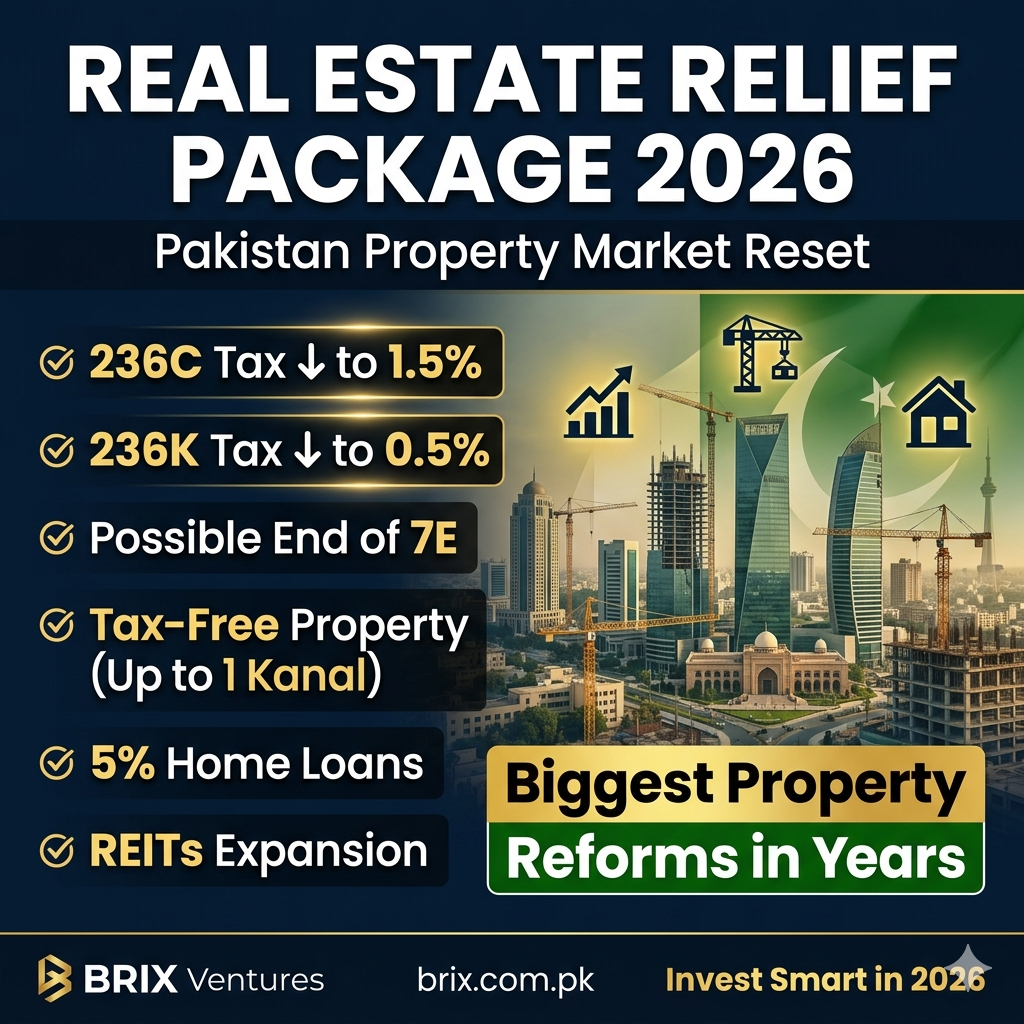
- Section 236C (seller tax) proposed at 1.5% – Currently, filer-rate tax under Section 236C on property sales is 4.5%, 5%, and 5.5% depending on transaction value. Cutting it to 1.5% would lower the seller’s burden, improve liquidity, and encourage movement in stagnant inventory. An additional suggestion suggests only 30% of 1.5% be applied where a property is sold within one year, aiming to stimulate short-term investment and quicker turnover.
- Section 236K (buyer tax) proposed at 0.5% – FBR currently lists filer-rate Section 236K tax at 1.5%, 2%, and 2.5% depending on fair market value. A reduction to 0.5% would directly reduce entry costs for buyers.
- No double tax regime – One of the loudest complaints in the property market has been layered taxation that feels repetitive and punitive. Eliminating this perception would be welcomed by both investors and end-users.
Relief for End-Users
- No tax up to 1 kanal plot or house – This proposal connects directly with middle and upper-middle-income genuine buyers. Reporting indicates proposals to abolish transaction taxes on the first ownership of a home or plot up to one kanal.
- No tax for first-time plot or home owner – First-time buyers are the lifeblood of sustainable real estate growth. They create genuine occupancy, genuine demand, and healthier downstream development.
- No tax on housing loan – One proposal under discussion is to treat housing loan instalments as an expense instead of part of income, reducing the tax burden and shifting Pakistan from a cash-dominated property culture to a financing-supported ownership model.
- Abolition of Section 7E – Section 7E (tax on deemed income) remains one of the most controversial issues in Pakistan real estate taxation. Abolishing or neutralising it for the sector would be a major relief signal. Why does this matter so much? Because 7E has come to symbolize the perception that real estate is being taxed in a way that does not always reflect actual cash flow, actual yield, or actual transaction activity. Removing it would reduce both cost and psychological resistance.
Beyond Taxes: Building a Modern Housing Finance Ecosystem
This is where the package moves from relief to reform. Pakistan is finally talking seriously about the architecture that supports a real housing economy.
REITs (Real Estate Investment Trusts)
REITs formalise investment, pool capital, improve governance, and allow broader participation in real estate growth. In January 2026, SECP announced amendments to the REIT Regulations, 2022 to simplify procedures, improve governance and controls, and increase transparency.
At BRIX Ventures, we have been closely following this space. For developers and investors looking to understand how REITs can be structured and leveraged, we offer exclusive solutions for REIT implementation and real estate capital markets.
Low-Cost Housing Loans at 5%
Recent reporting says the government has already rolled out a revised housing financing scheme with lower rates and a higher loan cap. The prime minister has been briefed about low-cost loan implementation.
RERA-Style Framework
A RERA-style framework matters for trust. Pakistan’s property market needs stronger consumer protection, project accountability, documentation discipline, and dispute reduction.
Uniform Valuation with Market Rates
This reform may sound technical, but it is one of the most important. A market cannot become transparent if official valuation, transaction valuation, and true market value remain disconnected. Greater alignment would reduce disputes, under-declaration incentives, confusion, and selective enforcement.
Mandatory Bank Lending Targets
Recent briefings to the prime minister confirm that banks will be given targets in the next phase. The mortgage-finance ecosystem work is in full swing, and developer-led financing systems are being formed.
Mortgage Market Development Through Bonds and PMRC Strengthening
PMRC exists precisely to address long-term funding constraints in housing finance. It issues bonds and sukuks to provide long-term funding to partner financial institutions so they can pass fixed and attractive rates to mortgage buyers.
Green Mortgages and Takaful-Based Housing Insurance
These forward-looking proposals can reward energy-efficient housing and expand protection in a culturally and financially relevant format.
How BRIX Ventures Views This Package
As financial consultants for real estate projects, we see this package as a rare alignment of fiscal relief and institutional reform. The proposals address the three core barriers that have kept Pakistan’s real estate market underperforming:
- High transaction costs – addressed by tax reductions on buyers and sellers
- Lack of financing depth – addressed by 5% loans, bank targets, and PMRC bonds
- Investor distrust – addressed by RERA, uniform valuation, and overseas-friendly rules
For developers, asset managers, and institutional investors, navigating this changing landscape requires careful structuring. Our strategic advisory services help clients position themselves ahead of regulatory shifts, structure compliant investment vehicles, and access emerging financing channels.
What Could Happen Next
The expectation in the market is that provincial taxes may also see reductions by late April or mid-May 2026, while federal tax changes could be reinforced or broadened in the budget. That remains an expectation, not a confirmed announcement. Still, it fits the broader pattern now visible in policy reporting: some steps can come quickly, while others will likely require budget treatment, legal drafting, provincial coordination, or IMF comfort.
The encouraging part is that the tone has shifted. Instead of treating real estate only as a documentation problem, policymakers appear to be looking at it as a growth platform, a housing platform, a financing platform, and an overseas capital platform.
In sha Allah, if the government follows through with consistency, consultation, and execution, 2026 could become a turning point for Pakistan’s property and construction landscape.